
Home Inspection Resources
Clear, practical information about radon measurement, indoor air quality sampling, and common residential inspection concerns.
These resources help buyers, sellers, homeowners, and real estate professionals better understand testing options, common conditions, and what inspection findings may mean before important decisions are made.
Why These Resources Matter
Residential inspections often raise questions about air quality, moisture, radon exposure, crawlspaces, and other environmental conditions.
These guides provide general educational information about common testing services, how they work, and situations where additional evaluation may be helpful.
Topics Covered
Radon measurement
Indoor air quality sampling
Moisture-related concerns
Pre-sale preparation
Common testing misconceptions
Radon Measurement Information
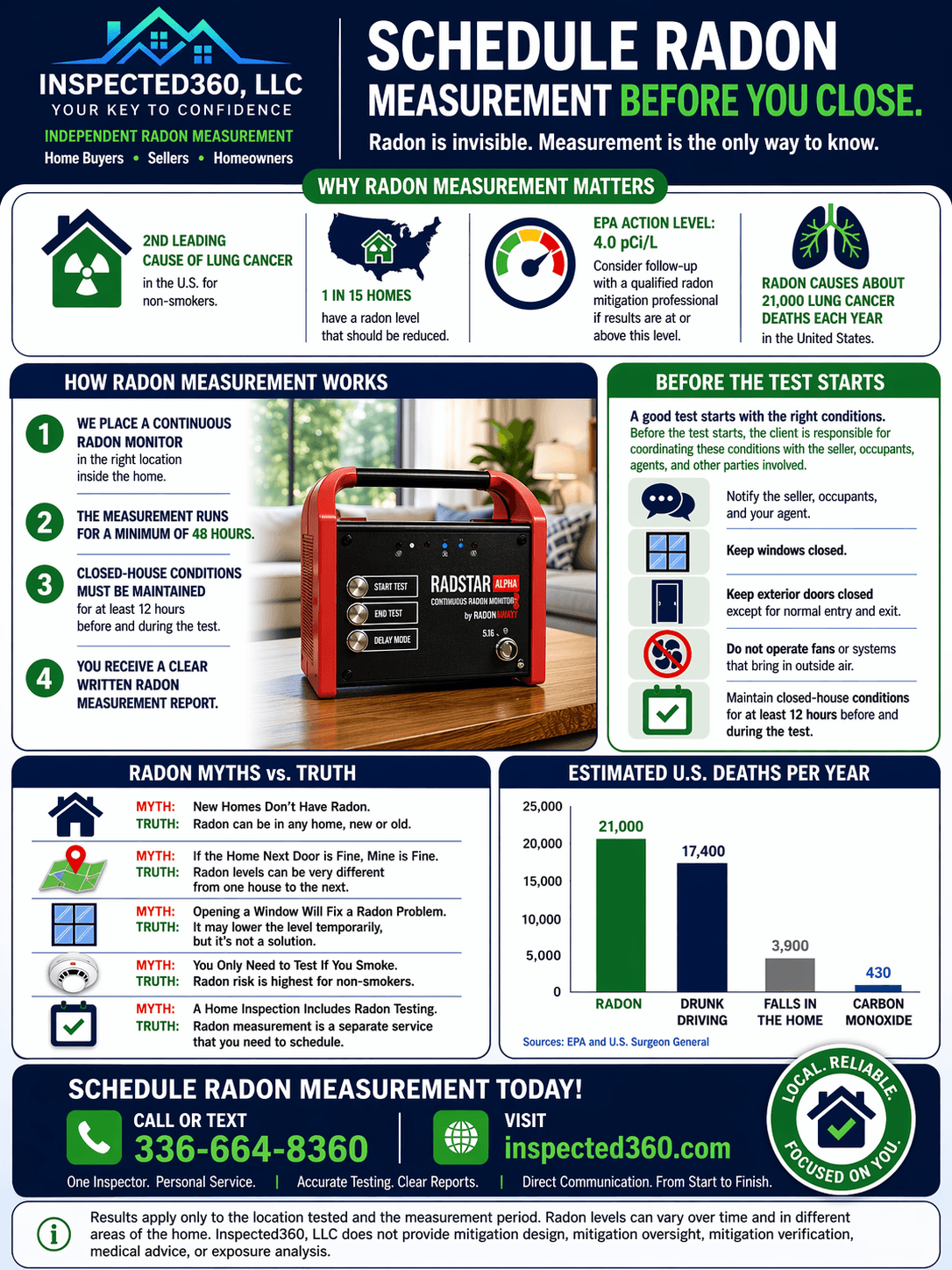
Radon is a naturally occurring radioactive gas that cannot be seen or smelled. A short-term radon measurement can provide useful information about radon levels at the tested location during the measurement period.
What This Resource Covers
Why radon measurement matters
EPA action-level guidance
Common misconceptions about radon
What to expect during testing
Closed-building testing conditions
Understanding radon measurement reports
Who This Information Helps
Home buyers
Home sellers
Homeowners
Real estate professionals
Radon Resource Summary
According to the EPA, radon is a leading cause of lung cancer, and testing is the only way to know your radon level.
The EPA recommends taking action when radon levels are 4.0 pCi/L or higher.
Short-term radon measurements typically require closed-building conditions and a minimum testing period.
Radon levels can vary between homes, even within the same neighborhood.
New homes can also have elevated radon levels.
Opening windows temporarily is not considered a reliable long-term radon solution.
Radon measurement results apply to the specific device location and measurement period stated in the report.
Inspected360 provides limited radon measurement services in Greensboro, NC and throughout the Piedmont Triad for residential real estate transactions and homeowner testing.
Indoor Air Quality Sampling
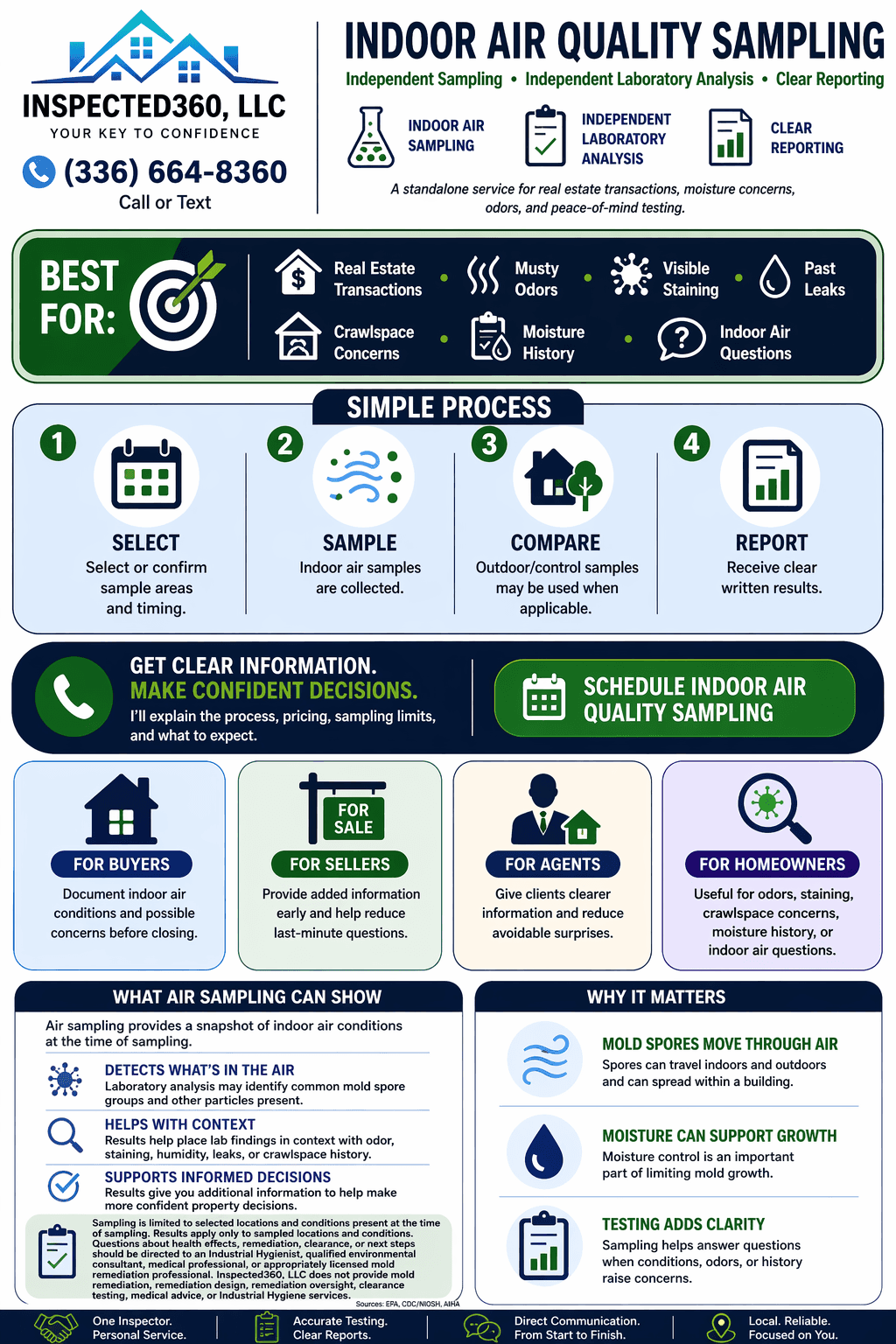
When musty odors, visible staining, past leaks, moisture concerns, or crawlspace questions come up, indoor air quality sampling can provide useful lab-based information. Samples are collected from selected areas and analyzed by an independent laboratory.
What This Resource Covers
Indoor air sampling basics
Independent laboratory analysis
Moisture-related concerns
Crawlspace and odor discussions
Understanding sample comparisons
Common situations where sampling may help
Common Situations
Musty odors
Visible staining
Past leaks
Crawlspace concerns
Real estate transactions
Pre-sale preparation
Indoor air quality questions
Indoor Air Quality Resource Summary
Sampling may provide information about airborne mold-related particles in the samples collected.
Results apply only to the specific sample locations, date, time, laboratory method, and conditions present at sampling.
Sampling may be useful when musty odors, visible staining, past leaks, moisture concerns, or crawlspace-related questions are present.
An outdoor/control sample is typically collected for comparison with selected indoor samples.
Independent laboratory results may help guide discussion and next steps.
Sampling does not identify the source, cause, duration, or extent of mold, moisture, odor, or other conditions.
Sampling is intended to provide additional information from selected air samples, not to diagnose every indoor air concern or determine what repairs may be needed.
Inspected360 provides independent indoor air quality sampling services in Greensboro, NC and throughout the Piedmont Triad for buyers, sellers, and homeowners seeking additional environmental information.
Frequently Asked Questions
Q
Is the inspection invasive?
A
No. Home inspections are visual, non-invasive, and limited to readily accessible systems and components. If specialized evaluation is recommended, it will be noted in the report.
Q
Do you inspect crawlspaces and attics?
A
Accessible crawlspaces and attics are inspected when conditions allow. Some areas may be limited by safety, access, storage, insulation, low clearance, moisture, pests, or other site conditions.
Q
Do you walk roofs?
A
I typically use drone imaging for roof inspections when weather, visibility, site conditions, and FAA rules allow. If drone use is not available, I use other safe vantage points, such as the ground, ladder, or windows, to document visible roof conditions as clearly as possible.
Q
What does the inspection report include?
A
The report includes photos, written comments, observed concerns, and recommendations when further evaluation may be useful. The summary is helpful, but clients should read the full report.
Q
Do you inspect septic, sewer, or WDO/termite issues?
A
Those services are not part of a standard home inspection. When requested, some services may be coordinated with or referred to independent providers. The provider performing the service is responsible for its own inspection, findings, and report.
Q
Do you offer indoor air quality sampling?
A
Yes. Inspected360 offers limited indoor air quality sampling when separately arranged. Samples are collected from selected areas and analyzed by an independent laboratory. This service is not a full indoor air quality assessment, mold inspection, health opinion, remediation protocol, or clearance test.
Q
Do you provide repair estimates?
A
No. The inspection report is not a repair estimate or contractor scope of work. When repairs or further evaluation are needed, contractors and qualified specialists should provide their own evaluations, pricing, and repair recommendations.
Q
Do you inspect new construction homes?
A
Yes. I inspect both new construction and existing homes. For new construction, the inspection focuses on visible and accessible conditions, not code compliance or builder warranty obligations.
Q
Do you offer maintenance inspections for homeowners?
A
Yes. A maintenance inspection can help homeowners better understand visible conditions and observed concerns before they become larger questions. It is not a warranty, maintenance plan, or prediction of future performance.
Q
Not sure which services you need?
A
Call or text and I’ll explain the available options based on the property and your specific concerns.
Q
Is infrared always used?
A
Infrared is used when conditions make it useful. It can help document temperature differences that may point to moisture, insulation, or electrical concerns, but it does not confirm hidden conditions.
Q
Is a home inspection a code inspection?
A
No. A residential home inspection is not a code compliance inspection, municipal inspection, engineering review, or warranty inspection. It is a visual inspection performed under the applicable North Carolina Standards of Practice.
Client reviews reflect individual experiences and do not expand the scope of any inspection, report, agreement, or service. Inspection scope, limitations, report use, and service terms are controlled by the written agreement for the service selected.
Contact Us
We're open for business and available to answer any of your questions about home inspections.
We promise to respond promptly!